
Madrid, 19 October 2025 —
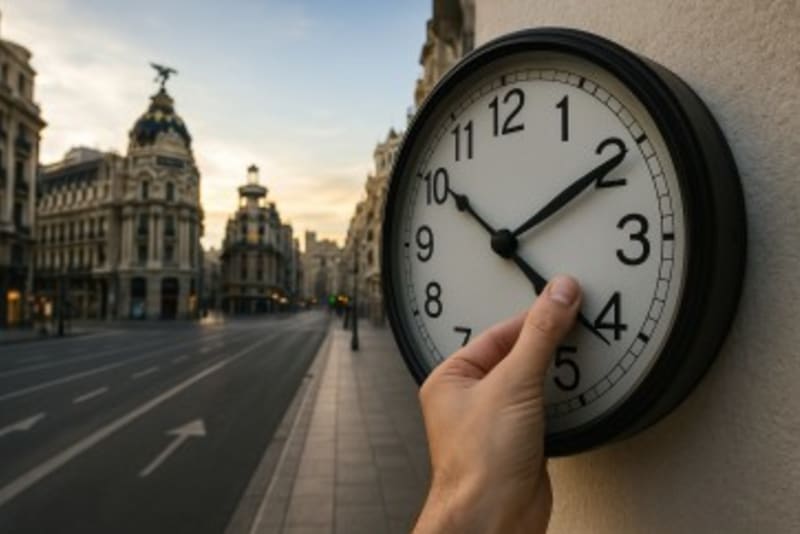
As autumn advances, Spain is gearing up for its annual switch from summer daylight-saving time to standard time (often called “winter time”). According to official sources, at 03:00 on Sunday, 26 October 2025, clocks on the mainland and in the Balearic Islands will be turned back one hour to 02:00, creating a 25-hour day. Meanwhile, in the Canary Islands the change occurs at 02:00, which becomes 01:00. Euro Weekly News+1
Why the Change and What It Means
Twice a year, Spain adjusts clocks in order to align human activity more closely with daylight hours. This system is part of the wider European practice of switching between summer time (daylight saving) and standard time. Fascinating Spain+1
By turning the clock back one hour in late October, mornings become lighter sooner (which benefits early commuters and school runs), though evenings will darken earlier. Time and Date+1
But the practice is not without debate. Some experts argue the benefits (energy savings, alignment with daylight) are modest at best, and that the twice-yearly shift disrupts sleep and biological rhythms. Fascinating Spain
What to Do and What to Check
Officials recommend that you:
-
Reset any manual clocks or devices that don’t change automatically (wall clocks, ovens, older cars).
-
Check travel or transport bookings around the night of the change — for instance, overnight trains or flights may appear twice at the same nominal time. Euro Weekly News
-
Note that the extra hour of sleep (on Sunday) is short-lived: from Monday normal routines resume under the new time.
-
If you have cross-border dealings (business calls, meetings) remember that not all countries change their clocks on the same date.
Direct Voices & Reactions
“At 03:00 we will set the clock back to 02:00 in peninsular Spain — it’s an extra hour, but also an earlier dusk,” said a spokesperson for the Spanish time-regulation service.
“We advise all households and businesses to check analog clocks which won’t switch automatically,” added the transport ministry.
These remarks reflect the official stance that the change is routine, but practical preparation still helps avoid confusion.
Looking Ahead: The Debate Continues
While the 26 October 2025 change is confirmed and the system remains in place, discussion continues within the European Commission and Spain’s government about whether the twice-yearly clock shift should persist. La Vanguardia+1
Should a decision be made to abolish the change, Spain would need to select either permanent standard time or permanent daylight saving time — each option carrying distinct social and economic implications (morning light vs evening evening light).
What It Means for You
In practical terms:
-
Sunday 26 October will last 25 hours on the mainland and Balearics.
-
Most digital devices will adjust automatically, but many manual clocks will not.
-
Early-morning light improves; expect earlier sunsets and possibly an adjustment in your routine.
-
The time-change system remains unless formal reform is enacted.





Comments
No comments yet. Be the first to comment!